Is an ultra-short-throw projector right for your room?
A checklist for deciding whether a UST projector fits your wall, console, screen surface, light conditions and alignment tolerance.
Understand the room and screen conditions that make ultra-short throw projection worth considering, and the checks that can rule it out.
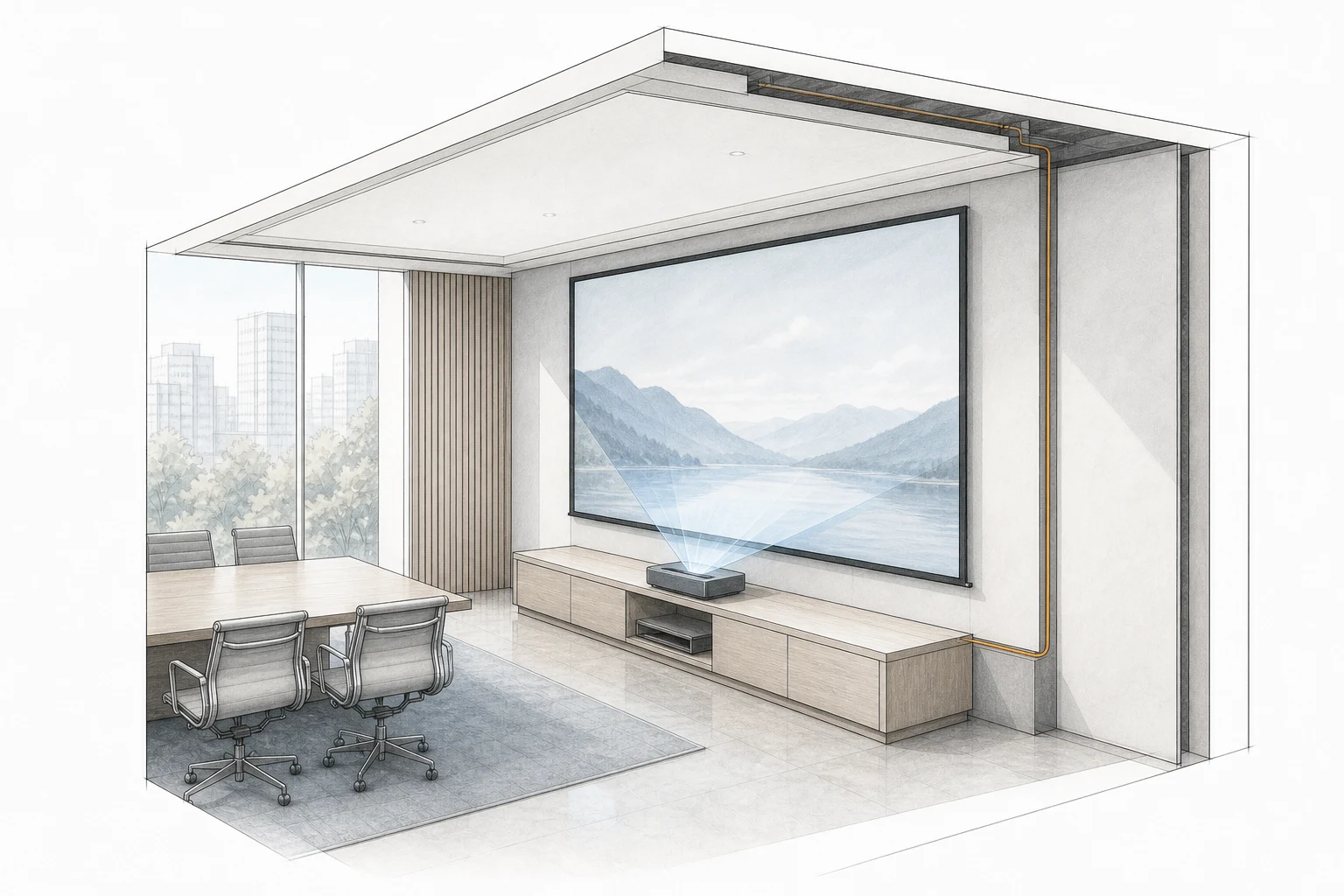
Select a numbered marker to inspect the room detail.
A UST projector can create a large image from a position close to the wall, which may suit a compact room or a room where a ceiling mount is undesirable. The short distance does not make the system plug-and-play. Small changes in projector position, screen flatness, console height and ambient light can be visible in the image.
UST suitability checklist
UST wall, screen and console geometry
The wall, screen plane, projector footprint and console work together to set image height, offset and service access.
- The intended wall or screen is flat enough for the projector's optical geometry.
- There is a stable, level location for the projector with the model's required clearance.
- The console or cabinet is deep and wide enough, and its height puts the image where the seating needs it.
- The screen surface is suitable for UST; a fixed-frame or tab-tensioned option may be a better starting point than a loose surface.
- Windows, luminaires and other ambient light sources are understood before choosing brightness or screen material.
- The projected image does not cross shelves, doors, artwork, wall texture or trim.
- The model's throw distance, offset and adjustment range have been checked from the actual position.
- There is a practical way to align, focus, service and protect the equipment.
The screen surface matters
UST light reaches the screen at a steep angle. A surface that looks acceptably flat from a normal viewing position may still show waves or geometry errors when lit from below. Fixed-frame and tab-tensioned screens are common candidates because they provide more controlled tension, but the exact screen material and projector pairing must be confirmed.
Console height and placement
Measure the console top, the wall above it, the projector footprint and the intended bottom and top image edges. A typical furniture height may place the image too high or leave too little adjustment. Do not move the projector by eye after the screen is installed; use the model's setup geometry and a straight reference.
Alignment and room light
UST alignment is sensitive to small lateral, vertical and rotational errors. Digital correction can help in some models, but heavy correction may affect image geometry or image quality. Daylight and room lighting can also reduce perceived contrast; the screen and projector should be evaluated together in the real room.
Questions to answer before choosing UST
- What image width and aspect ratio are actually required?
- What exact UST model and lens geometry are being considered?
- Can the wall, screen, console and projector stay fixed and level?
- Will the room be used with daylight, task lighting or lights behind the audience?
- Does the room need the wall for shelving, art, doors or other displays?
- Can the installation be measured, aligned and serviced without moving furniture?
- Would a conventional short-throw or standard-throw position give the room more tolerance?
Next action
Send a straight-on wall photo, console width/depth/height, intended image width, room-light notes and the exact projector model. A model-specific review can then decide whether UST is suitable or whether another throw geometry is more forgiving.
Keep planning.
Start with a photo-first UST survey
Send a straight-on wall photo, console width/depth/height, intended image width, room-light notes and the exact UST model.
Start with a photo-first UST survey