Projected safety signage for warehouse floors.
A ceiling-mounted gobo projector casts a STOP sign, an arrow or a lane boundary onto the floor as light rather than paint or tape. Big Shine surveys the floor and its light, supplies the units and gobos, and installs and aims them for the traffic that has to read them.
Unit class, gobo artwork and mounting are confirmed after the site survey, which includes a light reading at the floor. No pricing is published; enquire for a quote.

Paint wears. Tape peels. Light is re-aimed.
Floor marking in a working warehouse is driven over, dragged across and covered in tyre marks and dust, and every repaint takes the area out of use while it dries. A projected mark sits on the ceiling, not the floor: it is not worn by traffic, it can be switched on with a shift or a hazard, and moving it is an aiming adjustment rather than a floor job.
It is still a visual cue, not a barrier. The mark has to be bright enough for the measured light, aimed for the direction people approach from, and kept clean, which is why the work starts with a survey rather than a model number.
Six places a projected cue earns its place.
Forklift lanes
Lane edges and direction arrows at the points where paint is driven over most, projected from above so the mark is not under the tyres.
Pedestrian crossings
STOP, look and walkway cues where people and vehicles share a floor, aimed at the direction each group approaches from.
Hazard areas
Keep-clear boundaries around charging bays, racking ends, dock levellers or machinery, switched on when the hazard is live.
Loading docks
Bay markings and vehicle-movement cues that can be re-aimed as the dock layout or the traffic plan changes.
Temporary routes
A diversion or one-way route during works, put down and removed without floor preparation or drying time.
Storage zones
Zone labels and boundaries that move with a reslotting exercise instead of being ground off and repainted.
What a projected cue does not do.
A projected STOP sign or lane boundary supports the site’s workplace safety and health plan; it does not replace compliant signage, physical barriers, traffic management, lighting, procedures, training or supervision, and it does not certify anything. Whether it belongs in a given risk assessment is the site team’s call.
Five things measured on site.
- Floor. Finish, colour and how reflective it is. A pale epoxy floor and a dark stained concrete floor take the same projector very differently.
- Light. Ambient light at the mark, at the times it must be read, including skylights and dock doors. We measure this on site rather than estimate it.
- Height and structure. Mounting height, what the unit can fix to, and whether the position keeps clear of racking, sprinklers and conveyors.
- Traffic. Who needs to read the mark, from which direction, and how fast they are moving. This sets the image size and orientation.
- Environment. Dust, vibration, temperature and washdown, which decide the housing rating and how often the lens needs cleaning.
A crossing with a visible cue.
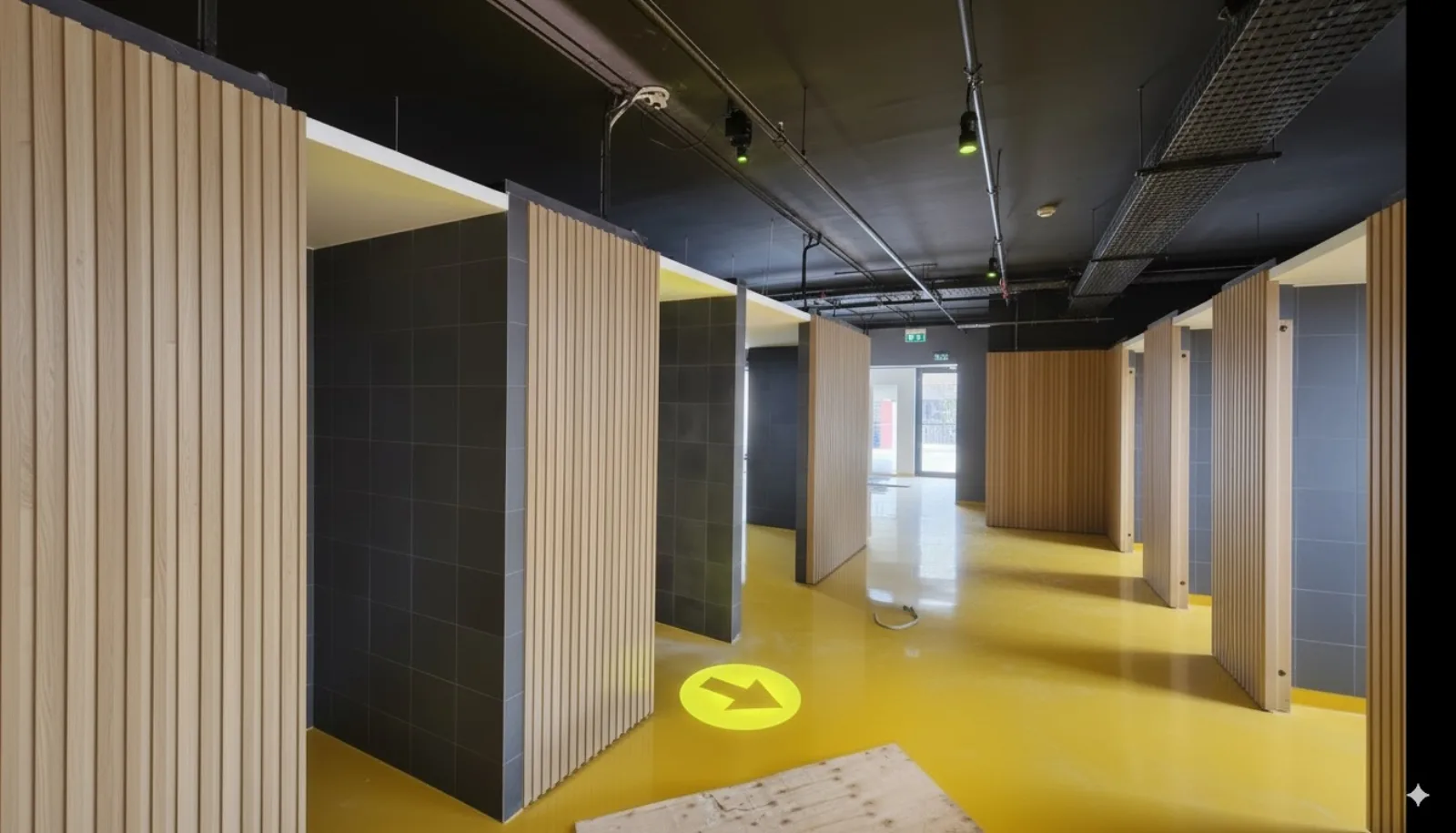
The project note states what the photograph shows and what has not been measured; no incident or maintenance outcome is claimed for it.
Before you plan projected floor cues.
Does it work in a bright warehouse?
Often, but not always. The brightness class is chosen against the ambient light measured at the floor, and some daylit floors under a skylight are too bright for a readable mark at the size wanted. The site survey answers this before anything is ordered.
What about dust and tyre marks?
A projected mark is not scuffed or covered by tyre marks the way paint and tape are, because nothing is on the floor. Airborne dust settles on the lens over time, so a cleaning interval is part of the handover; dust-rated housings are used where needed.
How is the message changed?
Each unit projects a gobo, a metal or glass stencil of the artwork. Changing a single-gobo unit means fitting a new gobo; multi-gobo units cycle through several on a timer. Re-aiming a unit moves the mark without any floor work.
Does a projected mark satisfy WSH requirements?
Workplace safety and health compliance in Singapore is the site’s responsibility and depends on the risk assessment for that floor. A projected cue is one visual layer in that plan alongside signs, barriers, procedures and training; it is not a certificate. We document the installed unit, position, image and light readings so the site team can include it in their own records.
What does it cost to run?
Units run from a mains supply and use an LED light source; consumption is on each model’s specification sheet and depends on the brightness class. No pricing is published here; the survey produces a quote for the units, gobos and installation.